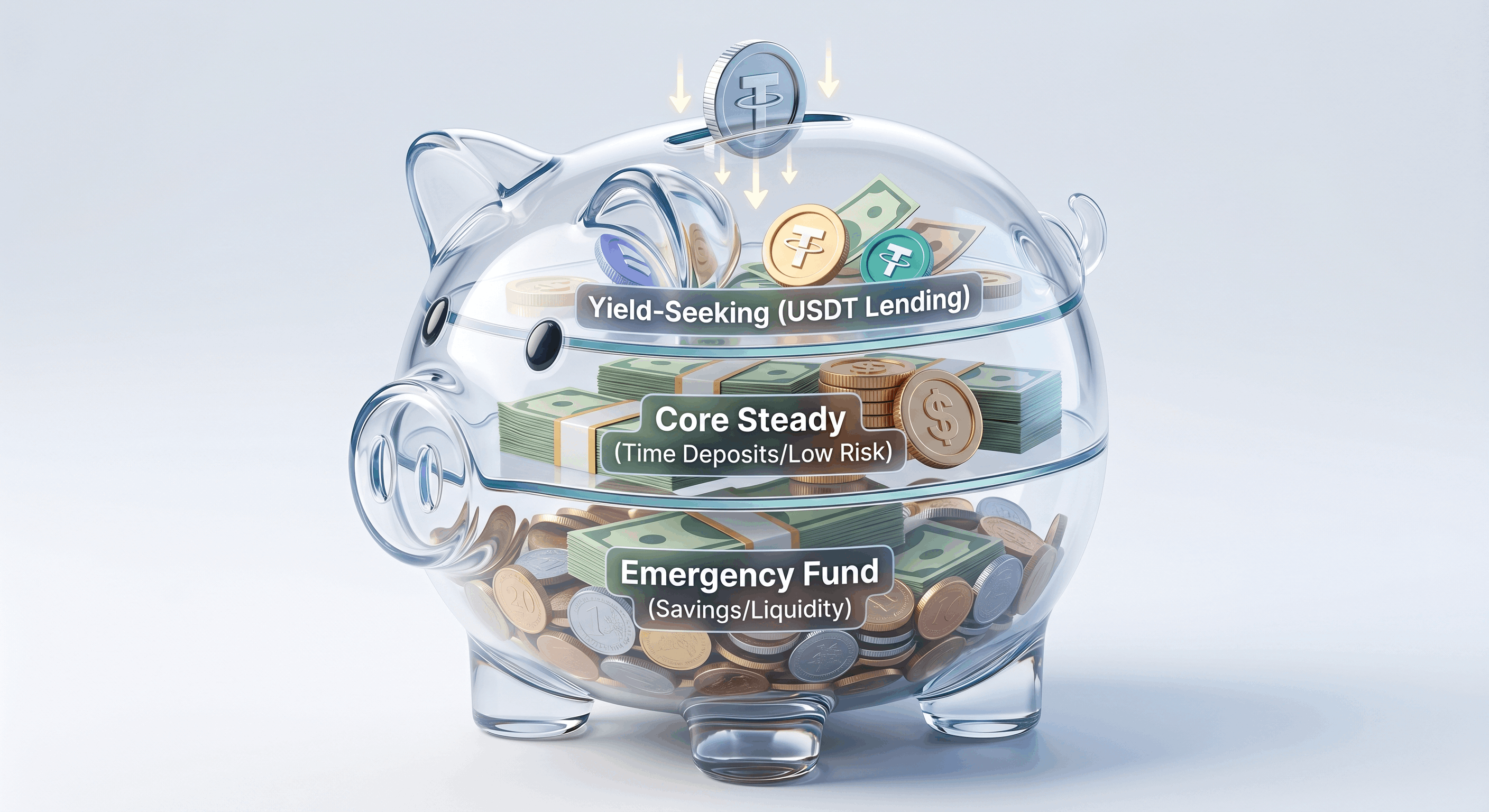
The bottom line: when a bear market has you scared to buy and your USDT sits idle, stablecoin lending is a sensible low-volatility option — it doesn't bet on price direction, it just earns interest from lending USDT to traders. Its value is "letting idle stablecoins earn at least some interest while you wait on the sidelines." But be honest about two things: bear-market lending rates are usually lower too (financing demand drops), and lending isn't risk-free (stablecoin depeg, exchange counterparty). Set the right expectation and it becomes a sensible parking spot for your wait-and-see period.
Why does idle USDT in a bear market suit lending?
In a bear or sideways market, many people don't dare chase highs or catch falling knives, so they convert to USDT and wait. But USDT just sitting there earns nothing, and inflation slowly dilutes its purchasing power. Lending offers a third path: don't bet on price, just earn interest. Because a stablecoin is pegged to the dollar, your principal doesn't shrink when prices crash (the biggest difference from "holding BTC spot") — making it suitable for riding out a period when you don't want to enter.
Lending vs. holding spot: how volatility differs
| Approach | Bets on price direction? | Volatility in a bear market |
|---|---|---|
| Holding BTC/ETH spot | Yes — gain on up, lose on down | High; may shrink sharply in a bear market |
| USDT just sitting | No | Low, but earns nothing + diluted by inflation |
| USDT lending | No — only earns interest | Low volatility, earns variable interest (not guaranteed) |
Lending's position is "low volatility, earn interest," not "bottom-fish for price gains." If you want to build a spot position during the bear market, that's a separate matter; lending is for those who "don't want to bet on direction right now but also don't want USDT just sitting."
Honest take: bear-market lending rates are usually lower too
Lending rates are set by the market's financing demand. In a bull market or during sharp volatility, leverage demand is high and rates are high; in a bear-market lull, trading is quiet and financing demand is low, so lending rates tend to be lower as well. So don't expect bull-market-level high rates in a bear market — its value is "better than just sitting, and low volatility," not "high returns regardless." Occasional panic sell-offs can briefly spike the rate; whether you catch those moments depends on whether you've automated (see below).
Risks to watch in bear-market lending
- Stablecoin depeg risk: stablecoins are meant to hold a 1:1 peg to the dollar, but not absolutely. Choose a large, reserve-transparent mainstream stablecoin.
- Exchange counterparty risk: assets sit on the exchange, so you must trust it.
- Variable, often-low rate: bear-market rates are already low — don't treat it as a high-yield tool.
To learn more passive-income forms USDT can take, see 6 common USDT passive income structures; lending is just one, but its low-volatility nature especially suits a wait-and-see period.
How not to miss occasional high rates even in a bear market?
Bear-market rates are mostly low, but panic sell-offs briefly spike the rate — those moments often land in the middle of the night and last only minutes. Automated lending services (EarnUSD, Cryptolend, Altinvest, Coinlend) check the market every minute and catch the fill when the rate briefly jumps. EarnUSD is non-custodial — principal stays in your own exchange account. To choose USDT or USD, see USD or USDT lending; for the live rate trend, check the rates page.
Conclusion
When a bear market has you scared to buy and your USDT sits idle, stablecoin lending is a sensible low-volatility option — no bet on price, just interest, letting funds earn at least a little while you wait on the sidelines. But set the right expectation: bear-market lending rates are usually low, and it carries stablecoin and exchange risk with a variable, non-guaranteed rate. It's not bear-market high-return magic — it's a "better than just sitting, no need to bet on direction" parking spot for your wait-and-see period. If your concern also includes local-currency depreciation, see hedging inflation with USD stablecoin lending.