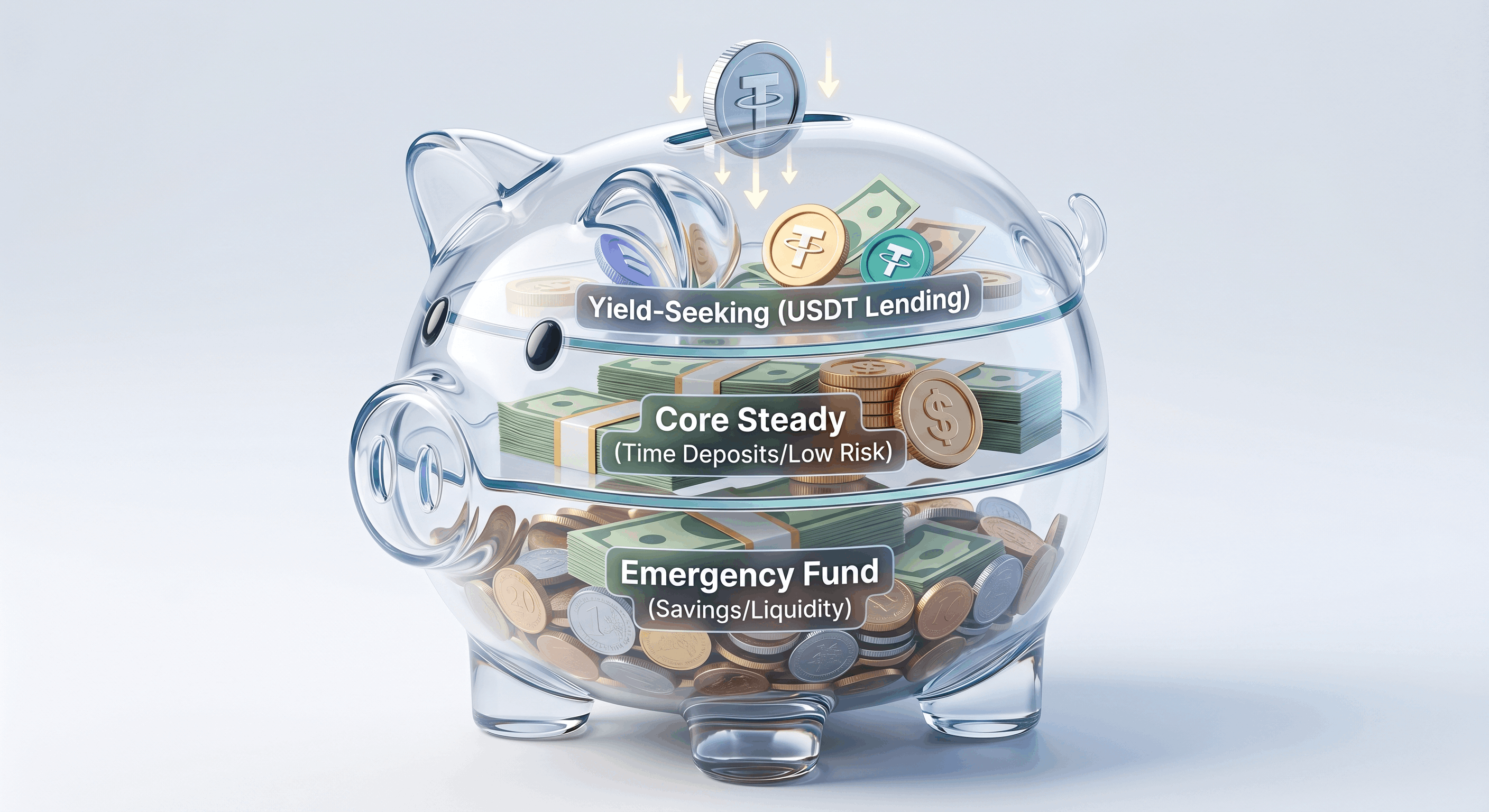
The bottom line: USD stablecoin lending combines "convert idle cash into a USD-denominated position" with "earn variable interest." It hedges your local currency depreciating against the dollar and cash sitting idle while inflation dilutes it; it does not hedge USD's own inflation, and it isn't risk-free — you take on stablecoin depeg risk and exchange counterparty risk. See that boundary clearly and it becomes a rational tool, not a sales pitch.
Why does cash "shrink" just sitting there?
Nominally your balance doesn't change, but inflation means the same money buys less — that's eroded purchasing power. The traditional answer is a fixed deposit, but in many currencies deposit rates can't keep up with inflation, and parking dollars in a bank often yields near zero. So a third path appears: hold a USD-pegged stablecoin and put it to work lending.
What is USD stablecoin lending?
Stablecoins (like USDT, USDC) are crypto assets pegged 1:1 to the US dollar — one coin is meant to equal one dollar. Lending means loaning those stablecoins to traders who need financing, earning interest. On an exchange like Bitfinex, the lending rate is set by market supply and demand, with a floating reference rate called the FRR. The appeal: returns are denominated in dollars and don't shrink when your local currency falls.
What it hedges, and what it doesn't
| Risk | Does USD stablecoin lending hedge it? |
|---|---|
| Local currency depreciating vs. the dollar | ✅ Yes — both the asset and yield are USD-denominated |
| Cash sitting idle, diluted by inflation | ✅ Partly — interest offsets some of it |
| USD's own inflation | ❌ No — pegged to the dollar, so it falls when the dollar does |
| Stablecoin depeg / issuer risk | ❌ Actually an added risk (see below) |
| Exchange counterparty risk | ❌ Actually an added risk |
Honest take: these risks can't be skipped
- Stablecoin depeg risk: stablecoins are meant to hold a 1:1 peg, but history has seen stablecoins briefly or permanently depeg. Choosing a large, reserve-transparent mainstream stablecoin lowers this risk but can't zero it out.
- Exchange counterparty risk: your assets sit on the exchange, so you must trust the exchange's own operation and solvency.
- The rate is variable: lending rates float with the market — not a fixed, guaranteed yield. In quiet markets the rate can be very low.
Think these three through and you'll know you're using "a tool to soften local-currency depreciation," not "magic that guarantees profit."
USDT or USDC? Which to lend?
Different stablecoins have different lending rates, liquidity, and exchange support. On Bitfinex, the USDT lending market is mature and liquid. To understand the rate and cost differences between USD and stablecoin (USDT) lending, see USD or USDT lending.
How do you automate it?
Lending well means catching the fill during high-rate windows, but no human can watch 24/7. Automated lending services (EarnUSD, Cryptolend, Altinvest, Coinlend) check the market every minute and post during high-rate windows for you. EarnUSD is non-custodial — it runs through a lend-only, no-withdrawal API, so principal stays in your own exchange account. To see the live rate trend, check the rates page.
Conclusion
If your goal is "don't let idle cash just sit and get eaten by inflation, and shift it into a USD-denominated position," USD stablecoin lending is a tool worth understanding. But remember its boundary: it hedges local-currency depreciation and idle cash, not USD inflation; it carries stablecoin depeg and exchange counterparty risk; the rate is variable, not guaranteed. Within those limits, it's one rational option — not a cure-all. If you're in a sideways or bear market and scared to buy, see bear-market stablecoin lending.