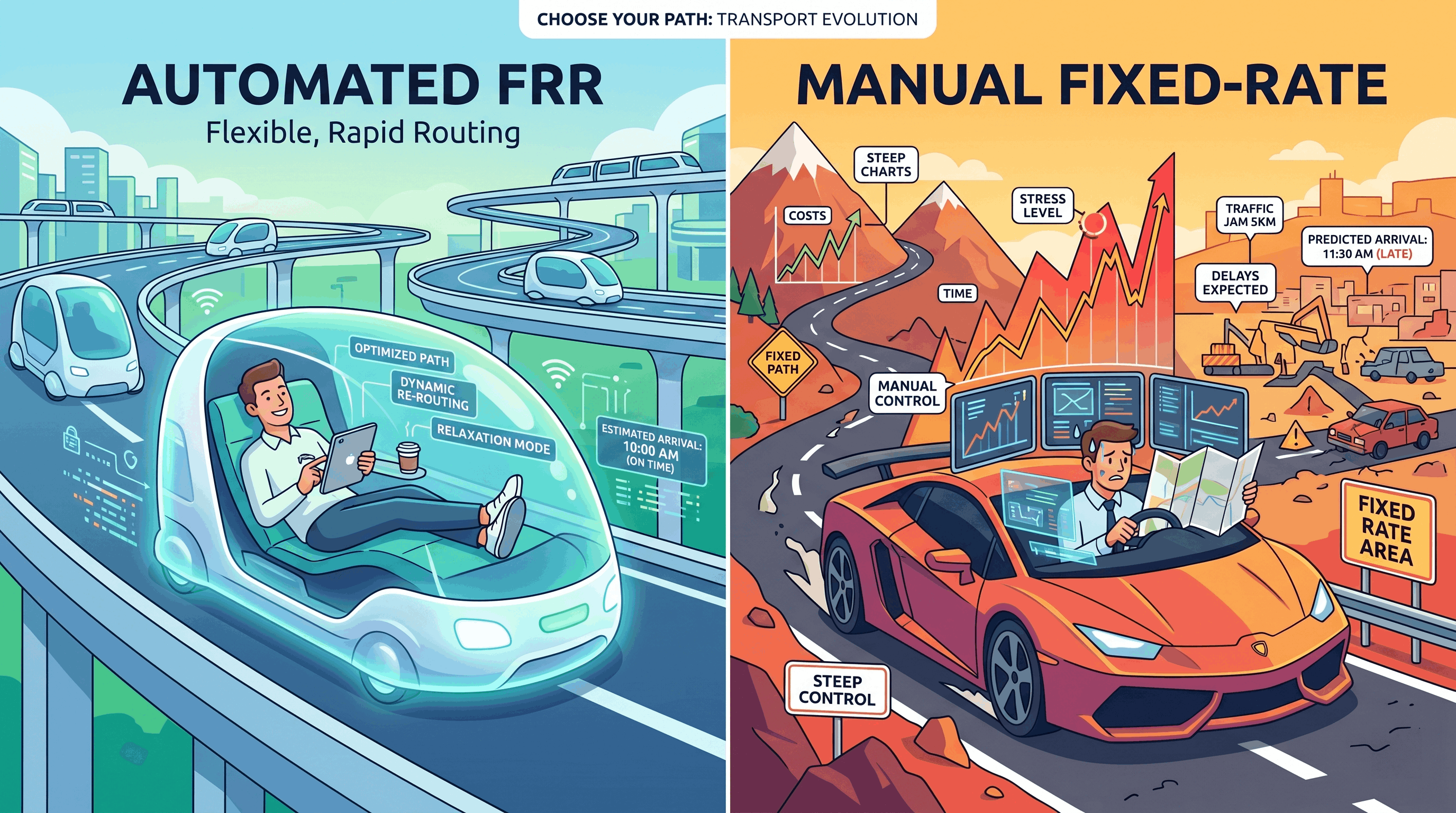
FRR (Flash Return Rate) is Bitfinex's "live market-average lending rate" — a volume-weighted average of all active fixed-rate funding offers, updated continuously. Set your funding offer to "FRR" and your rate automatically tracks the market instead of you quoting a price. Convenient, but FRR has a dilemma: when the market is quiet your funds sit idle waiting to be matched, and when rates spike you only ever earn the average, not the peak — it falls short in both directions.
This 3-minute guide covers how FRR is calculated, FRR vs a fixed rate, FRR's two blind spots, and how lending bots fill them.
How is FRR calculated?
Bitfinex lending is a P2P funding market: you post an offer ("lend at X% for Y days") and traders who need margin funding borrow it. FRR takes all currently active, matched fixed-rate offers and computes a volume-weighted average — a number representing "roughly what rate the market is matching at right now," updated continuously. In short, FRR ≈ the market's current going rate.
FRR vs a fixed rate — what's the difference?
| FRR (floating) | Fixed rate (you quote) | |
|---|---|---|
| Rate | Auto-tracks market average | You decide |
| Fill probability | Depends on demand — idle in quiet markets too | Too high → won't fill (idle); lower → fills easier |
| Need to watch the book? | No | Yes |
| Capture short-term high rates? | No (average only) | Yes, if you time the peak |
| Best for | Beginners / hands-off | Active traders |
FRR's dilemma: idle when quiet, capped when hot
Many assume "FRR always fills, so my funds never sit idle." That's a misconception. Because FRR tracks the average, it underperforms in both market regimes:
① Quiet market (low rates): low fill rate, funds wait
When few traders need to borrow (low demand), rates are low and even FRR offers may not get matched — your funds sit waiting, and a day unmatched is a day of 0 yield. "FRR = never idle" simply isn't true in a quiet market.
② Hot market (high rates): you fill, but only at the average
When volatility spikes and many traders rush to borrow, rates briefly surge (30–40% annualized is possible). But FRR is an average — it lags, and by design only pays you the average (maybe 12%). You get matched, but you miss the peak.
In one line: FRR makes you wait when it's quiet and underpay you when it's hot. It's the floor, not the ceiling.
So how do you cover both gaps?
The key is dynamic adjustment: nudge your rate down a touch in quiet markets so offers actually fill, and snap onto the spike the instant rates surge. That needs 24/7 monitoring and millisecond reactions — impossible by hand. That's why several lending bots exist, the common ones being EarnUSD, Cryptolend, Altinvest, and Coinlend. They differ in positioning: Coinlend supports multiple exchanges, Cryptolend has operated since 2016, Altinvest uses AI strategies with tiered fees, and EarnUSD supports USD/USDT/BTC and re-checks rates every 5 minutes. But their core goal is the same: adjust offers to fill when quiet, and grab rates above FRR when hot — covering both of FRR's gaps.
Bottom line: how should you use FRR?
- Pure beginner, just testing → use FRR to learn how lending works, but know you'll idle when quiet and earn less when hot.
- Maximizing long-term yield → use a bot to cover FRR's two gaps; the gap widens with capital and time.
In short: FRR is a passing grade; a bot scores on both ends.