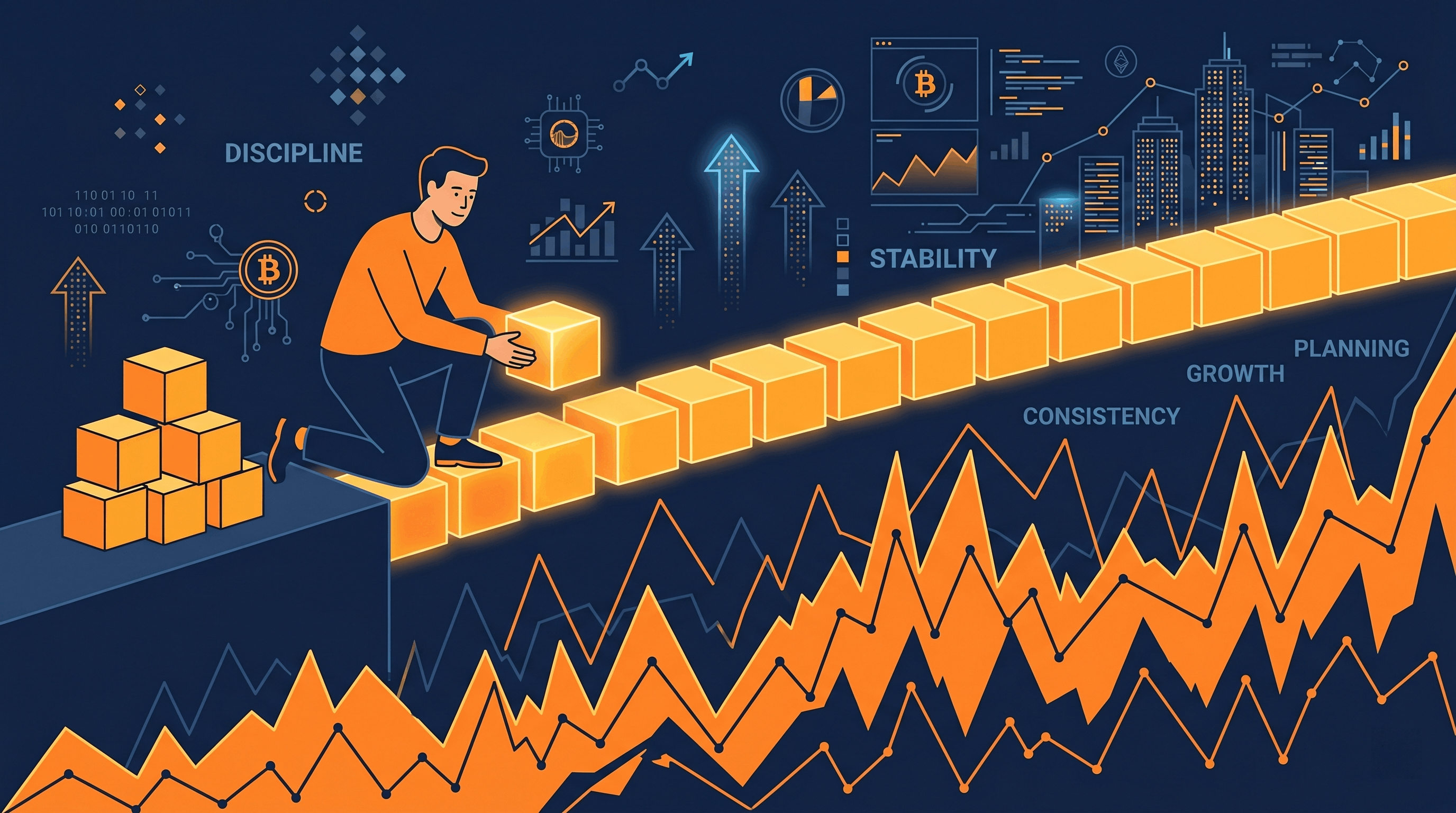
Short answer: dollar-cost averaging (DCA) means buying a fixed amount on a fixed schedule, so you spread your cost over time instead of betting it all on one price. It doesn't guarantee the highest return, but it lets you stop guessing tops and bottoms and replace emotion with discipline — which suits Bitcoin's brutal volatility. This guide covers how to calculate DCA returns, when DCA beats lump-sum (and when it doesn't), and a blind spot most people miss: the cash you're waiting to invest sits idle the whole time.
What is dollar-cost averaging (DCA)?
DCA means investing a fixed amount at fixed intervals (weekly/monthly), regardless of price. When the price is low your fixed amount buys more; when it's high it buys less. Over time your average entry price converges toward the period's average cost rather than being pinned to a single moment.
Why does this suit crypto especially? Because Bitcoin routinely swings 5–10% in a single day. Buying all at once stakes everything on the price the day you entered. DCA flattens that risk — the trade-off is "you earn a bit less in a strong rally" in exchange for "you don't get trapped at one high price."
How do you calculate Bitcoin DCA returns?
The core is the average-cost method: sum every contribution (total invested), divide by the total BTC accumulated, and you get your average buy-in price. Multiply current BTC price × total BTC for present value; the difference is your profit or loss.
A simplified example — $100 per month for three months:
| Month | BTC price | Invested | BTC bought |
|---|---|---|---|
| Month 1 | $50,000 | $100 | 0.00200 |
| Month 2 | $40,000 | $100 | 0.00250 |
| Month 3 | $60,000 | $100 | 0.00167 |
| Total | — | $300 | 0.00617 |
Average cost = $300 ÷ 0.00617 ≈ $48,600 (below the simple three-month average of $50,000, because you bought more at the low). If BTC is now $60,000, present value = 0.00617 × $60,000 ≈ $370, a ~$70 gain. To run your own amounts, intervals and price scenarios, use the EarnUSD calculator.
DCA vs lump sum: which fits whom?
| Dimension | DCA | Lump sum |
|---|---|---|
| Timing pressure | Low (no need to call tops/bottoms) | High (staked on one price) |
| In a long uptrend | Slightly lower return (capital enters later) | Higher return (fully in the market) |
| In a downturn | Resilient (averages cost down) | Easily trapped at one high |
| Best for | Volatility-averse long-term holders | Those with a clear entry thesis and risk tolerance |
Academically, on pure expected return lump sum usually edges ahead (markets trend up long-term, so earlier is better). But DCA wins on behavioral executability — it helps people actually keep investing instead of freezing when prices drop. For most retail investors, a strategy you can stick to beats a theoretically optimal one you can't.
The blind spot: DCA's "waiting" cash sits idle
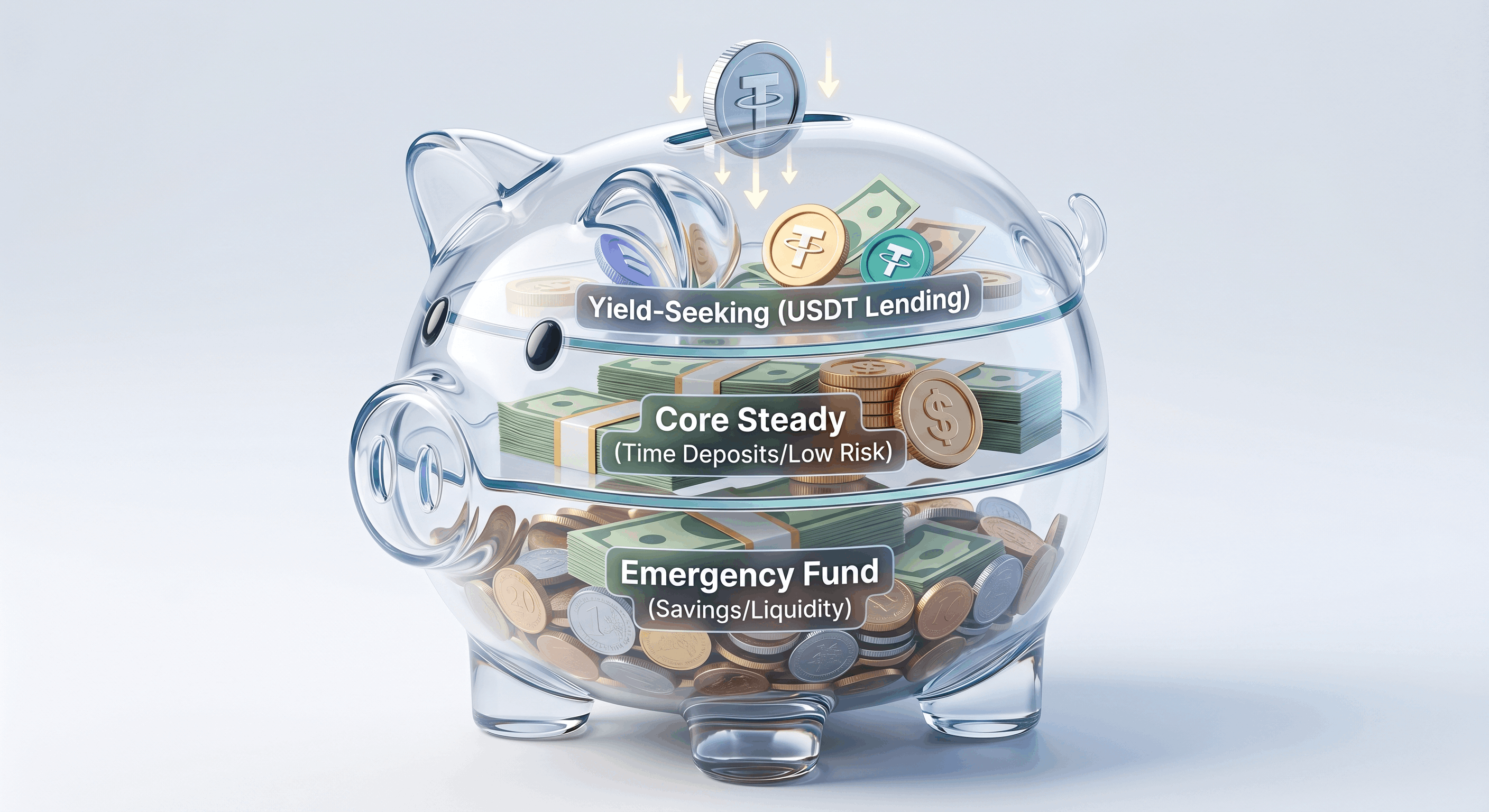
DCA has a hidden cost: the money you've set aside to invest gradually usually just sits in your account doing nothing until each buy. If you plan to deploy over a year, that "to-be-invested" cash is, on average, idle for much of it — neither in BTC nor earning anything. In crypto, idle stablecoins can be lent out for interest, and that opportunity cost shouldn't be ignored.
How EarnUSD does it: DCA and lend at the same time
This is exactly what EarnUSD is built to solve. Its USD-DCA feature lets your idle USD on Bitfinex both dollar-cost-average into BTC on schedule AND lend out the not-yet-invested portion for interest — so the cash never just waits. In practice:
- To-be-invested USD → auto-lent, earning interest on the Bitfinex funding market (supports USD/USDT/BTC, scans for high rates every minute);
- On the scheduled date → it auto-transfers your set amount to spot to buy BTC, completing that period's DCA;
- Entirely non-custodial — it only uses a lend-only, no-withdrawal API, so your principal always stays in your own Bitfinex account.
The result: you get both "DCA cost-averaging" and "interest on cash that would otherwise wait." To understand the lending side, see what FRR is and the difference between APR, APY and ROI.
Conclusion
DCA's value isn't "earning the most" — it's "replacing market-timing with discipline and spreading risk over time," letting you hold Bitcoin long-term without being scared out by short-term swings. Figure out your amount and interval (use the calculator), and pick an approach that keeps even the waiting cash working. Over time, that gap adds up.